Showing Posts From
Rpm
 CreatorPlaybook Team
- 01 Nov, 2026
Shorts vs Long-Form Earning: How Many Shorts Views Equal 1,000 Long-Form Views? (2026 Data)
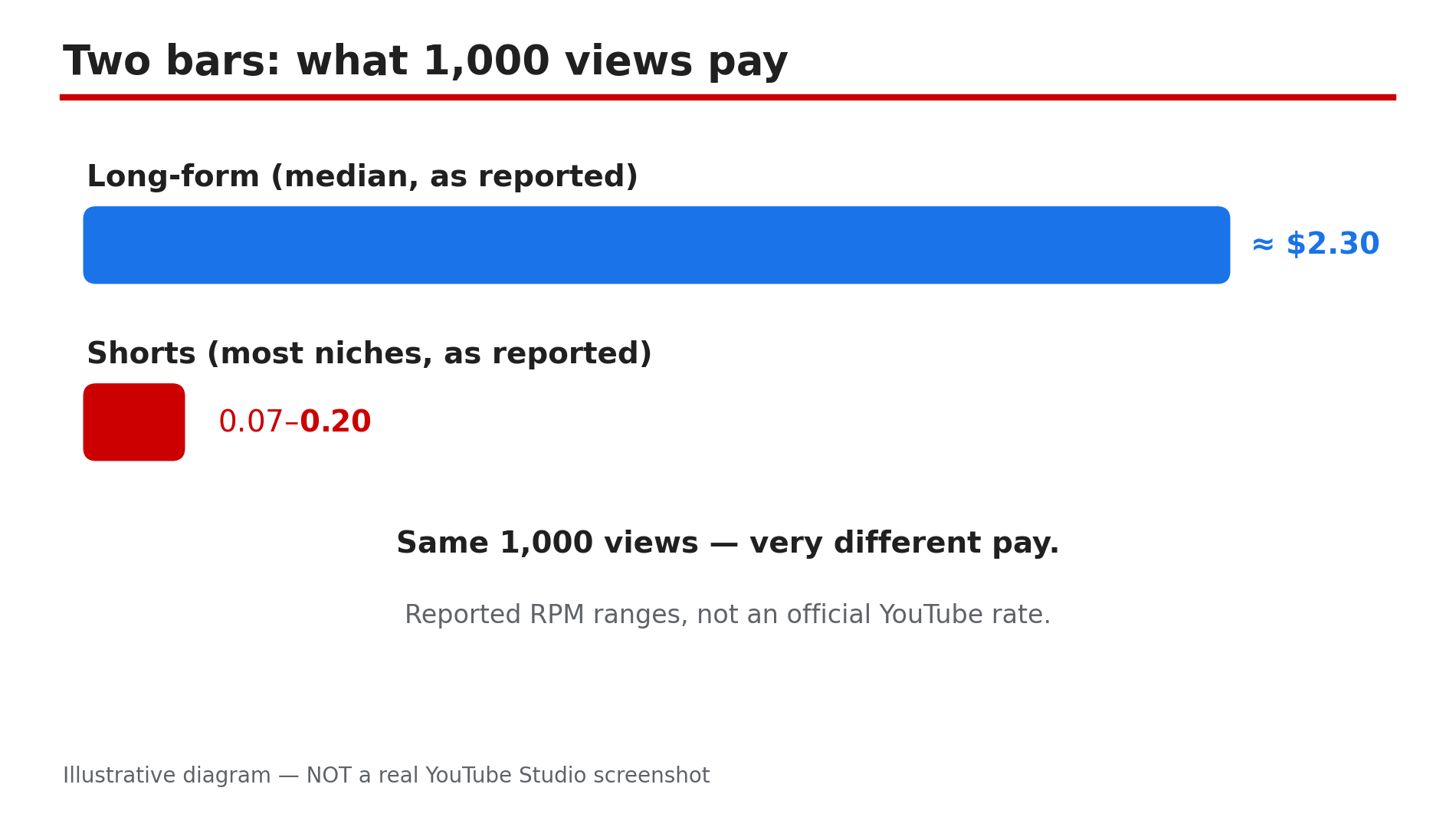
A Short with 100,000 views can earn less than a long video with 1,000 views — because on YouTube a view is not a view: the two formats are paid through completely different systems. As reported in a 2026 study of 274 channels, Shorts typically earn only 3–14% of long-form earnings per 1,000 views in the same niche. Shorts reach new people fast; long-form is where the ad money lives. YouTube publishes no fixed RPM — the figures are ranges that move with your niche and your audience's country. Below: both pay systems, the reported 2026 numbers, your channel's maths, and the February 2027 changes. Every third-party figure is labelled as reported; confirm your own numbers in Studio. What You Will Learn55% long-form, 45% of a pool on Shorts Reported 2026 RPM ranges by niche How many Shorts views equal 1,000 long-form views Where to find your real RPM in Studio What changes on 1 February 2027: the 10-million and 20-million figures How to mix Shorts and long-formStep 1 — Understand the Two Different Pay Systems What to do: Learn how each format is paid. How: On long-form, ads play on the video itself, and YouTube's Help pages confirm the creator keeps 55% of that ad revenue. Shorts carry no ads on the individual Short: ads run between Shorts in the feed, YouTube pools that revenue monthly and splits the Creator Pool by each creator's share of engaged views. Creators keep 45% of their allocation. Music changes the pool, not the rate. Example: YouTube's own example: a $90,000 pool and 100 million engaged views — a Short with 1 million engaged views gets 1% ($900), so $405 after the 45% share. Common mistake: Assuming a Short pays like a long video with the same view count — one is a share of a pool, the other a direct cut of ads.Illustrative diagram — reported RPM ranges, not an official YouTube rate. Step 2 — Read the RPM Ranges, Never a Fixed Rate What to do: Treat every RPM figure as a range — check its niche and country. How: RPM is revenue per 1,000 views: what a creator actually receives after YouTube's cut. YouTube publishes no official RPM, so the figures come from third-party studies of real Studio data, the largest recent one by AIR Media-Tech and MilX, covering 274 monetised channels. As reported, median long-form RPM was about $2.30 per 1,000 views, while most Shorts RPMs clustered at $0.07–$0.20 per 1,000 engaged views. Niche matters most: as reported, music is the exception at 41–60% of long-form ($0.97–$1.48). Gaming sat near $0.17, most others in the $0.07–$0.20 band. Country matters too: as reported, a mostly US audience paid around $0.328 per 1,000 Shorts views, an Indian audience far less. Example: Two channels with 100,000 Shorts views each: the music channel might earn roughly $97–$148, as reported; a general channel roughly $7–$20. Common mistake: Quoting one fixed number as if it were YouTube's rate — without a niche and a country, it probably is not your channel's rate.Illustrative diagram of the four-step Creator Pool process described in YouTube Help. Step 3 — Do the Maths: How Many Shorts Views Equal 1,000 Long-Form Views? What to do: Turn the ranges into a view count you can picture. How: In the 274-channel study, as reported, Shorts RPM was 3–14% of long-form RPM in most niches, so most channels need roughly 11,000–34,000 Shorts views to earn what 1,000 long-form views earn. Most niches sit at 11,000–26,000, gaming near 18,600, music about 1,100. Divide your long-form RPM by your Shorts RPM: at $2.30 and $0.10, the answer is 23, so 23,000 Shorts views match 1,000 long-form views. The study measures Shorts RPM per 1,000 engaged views, not raw plays. Example: A small education channel earns $2.50 per 1,000 long-form views and $0.08 per 1,000 Shorts views — $2.50 ÷ $0.08 is about 31, so about 31,000 Shorts views match 1,000 long-form views. Common mistake: Comparing view counts across formats — compare revenue, not views.Illustrative diagram — reported ranges from the 274-channel study, not a fixed rate. Step 4 — Check Your Own Numbers in YouTube Studio What to do: Read the two RPMs for your channel. How: In YouTube Studio on a computer, open Analytics, then the Revenue tab, for RPM and estimated revenue. Compare both RPMs over the same 28-day period, looking at the revenue column, not the views column. The Earn tab shows which modules you have accepted, including the Shorts Monetization Module, required before any Shorts views count toward revenue sharing — views earned before you accept it are not eligible, as YouTube's Help page states. Also check Shorts for Content ID claims in Studio > Content — a claimed Short over one minute long can be blocked and earn nothing. Example: One creator with 2 million Shorts views a month and 50,000 long-form views found the long videos earned over three times as much as the Shorts combined. Common mistake: Never opening the Revenue tab — views are a reach metric, revenue is a money metric.Illustrative diagram — niche and audience country move RPM more than view count does. Step 5 — Plan for the February 2027 Rule Changes What to do: Learn the two February 2027 figures. How: Announced 10 August 2026, effective 1 February 2027. First, the entry bar for new applicants: a new channel needs 1,000 subscribers plus either 8,000 qualified watch hours in 12 months or 20 million qualified Shorts views in 90 days — double today's 4,000 hours or 10 million views, for new applicants only, as reported. Second, the ongoing Shorts threshold for everyone already in the programme: a channel needs at least 10 million qualified Shorts views in the last 90 days to earn Shorts revenue that month, per YouTube's Help page. Below 10 million, Shorts revenue pauses while long-form keeps earning. Example: With 12 million Shorts views in the last 90 days, a channel keeps its Shorts revenue in February 2027; at 8 million it loses Shorts revenue that month but keeps all long-form earnings. Common mistake: Saying '20 million views or you lose monetisation' — twenty million is the new entry bar, ten million the rolling monthly bar.Illustrative diagram — 20 million is the new entry bar, 10 million is the rolling monthly bar. Step 6 — Build a Mix Where Each Format Does Its Best Job What to do: Give each format its best job instead of choosing between them. How: Use Shorts for discovery: a Short reaches new people, and a good one can send some to a related long video through the Related Video link or a pinned comment. Use long-form for depth and money: tutorials where viewers stay for minutes, watch mid-roll ads, build watch time. As reported, in the 274-channel study Shorts brought in under 2% of total revenue for most channels — a Shorts-only channel builds reach without building income. Example: A cooking creator posts two Shorts a week — quick tips and teasers — and one long video teaching the full recipe: the Shorts bring subscribers, the long video earns the revenue. Common mistake: Going all-in on Shorts because the views feel exciting — views are not income.Illustrative diagram — a suggested upload mix, not a guaranteed result. Checklist☐ My long-form and Shorts RPM from Studio > Analytics > Revenue ☐ My views-equivalent number (long-form RPM ÷ Shorts RPM) ☐ Shorts Monetization Module accepted in Studio > Earn ☐ Whether my audience is mostly in a high- or low-paying country ☐ My Shorts checked for Content ID claims in Studio > Content ☐ February 2027: 20 million is the new entry bar; 10 million is the rolling bar ☐ Updated terms accepted before 31 January 2027 (if already in YPP) ☐ Upload mix gives long-form a real shareFAQs 1. How much does YouTube pay per 1,000 Shorts views? No official fixed rate exists. As reported in the 2026 AIR Media-Tech study of 274 channels, most niches earned $0.07–$0.20 per 1,000 engaged Shorts views, music far higher at $0.97–$1.48 — confirm your own figure in Studio. 2. How many Shorts views equal 1,000 long-form views? As reported, most channels need about 11,000–34,000 Shorts views, because Shorts RPM is roughly 3–14% of long-form RPM; music needs far fewer, around 1,100. 3. Why do Shorts pay so much less than long-form? The systems differ: long-form pays a 55% share of ads on your own video; Shorts pay a 45% share of a monthly pool divided by each creator's share of engaged views. 4. Do I need 10 million or 20 million Shorts views from February 2027? Both are real, for different things, as reported. From 1 February 2027, new applicants need 20 million qualified Shorts views in 90 days (or 8,000 watch hours) to join; existing partners need 10 million in the last 90 days to earn Shorts revenue that month. 5. Should I stop making Shorts and only make long videos? Usually not: Shorts are still the fastest way to reach new viewers. Use a mix — Shorts for discovery, long-form for depth and income. SourcesYouTube Help — "YouTube Shorts monetization policies": Creator Pool process, 45% share, music splits, engaged views, and the 10-million rule from 1 February 2027. Opened live 1 Nov 2026. https://support.google.com/youtube/answer/12504220?hl=en YouTube Premium revenue, explained — CreatorPlaybook (internal): Premium viewers as a second income stream. /blog/youtube-premium-revenue-explained-how YouTube CTR suddenly dropped after 24 August 2026 — CreatorPlaybook (internal): engaged views, not raw plays, now count. /blog/youtube-ctr-suddenly-dropped-after-24All third-party study figures (AIR Media-Tech / MilX, 274 channels, Sept 2026) are presented as reported, not as official YouTube figures. Confirm your earnings in Studio.