Fair Use Myths on YouTube: What Actually Counts for Reaction and Commentary Videos
 CreatorPlaybook Team
- 31 Oct, 2026
You open a reaction video, press play on someone else’s clip, laugh at it for ten seconds, and call it fair use. Many creators do this — and many are wrong. The myths around fair use are repeated so often they sound like rules. They are not rules: no safe number of seconds, no magic disclaimer, no credit line that turns a copy into fair use.
Fair use is a defence in US copyright law, not a permission slip. As reported, courts decide it case by case under four factors, and YouTube’s Help page says the same. Content ID cannot decide fair use either, so a claim can still arrive. This is general information, not legal advice.
What you will learn
- The five fair use myths that get reaction channels claimed
- The four factors courts weigh, as reported, and how they apply to reaction videos
- How to structure a reaction video so your commentary does the heavy lifting
- How to handle a Content ID claim or takedown, and when to dispute
Step 1: Drop the “30 seconds is safe” myth
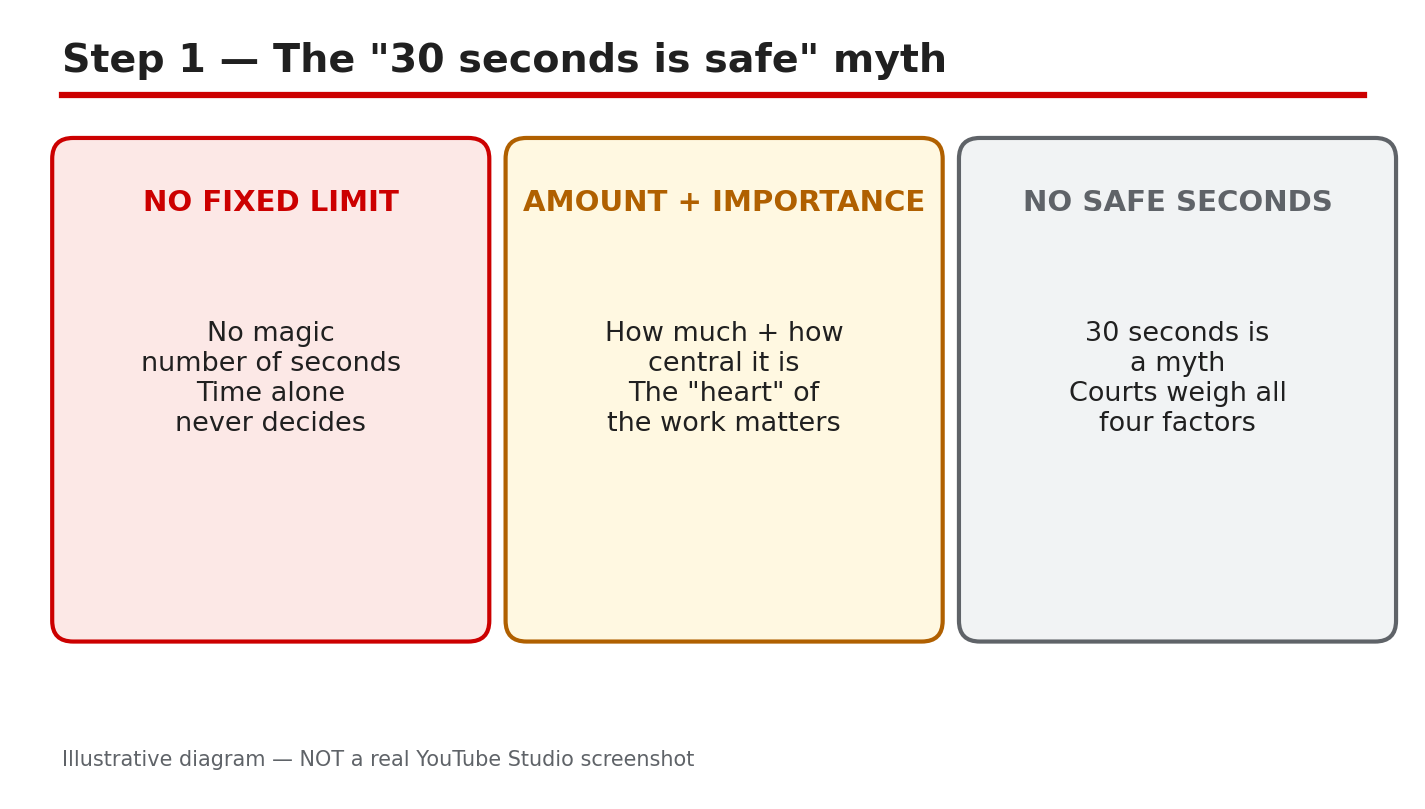
What to do: Stop planning your edits around a seconds rule, because no such rule exists in the law.
How to do it: As reported by the US Copyright Office, no formula guarantees that a set amount of a work can be used without permission. Courts weigh how much you used and how important it was, and YouTube’s Help page confirms even a few seconds can draw a claim.
Example: A creator plays the final ten seconds of a movie trailer — the big reveal — with no comment. That short clip is the “heart” of the work.
Common mistake: Cutting a clip to exactly 29 seconds because a forum post said 30 seconds is safe.
Illustrative diagram (mock-up): no safe number of seconds for fair use — not a real YouTube Studio screenshot.
Step 2: Learn why giving credit does not protect you
What to do: Treat credit as good manners, not as a legal shield.
How to do it: YouTube’s Help page states it plainly: giving credit will not by itself turn a non-transformative copy into fair use. As reported, infringement is about unauthorised use, not plagiarism.
Example: A channel credits the original creator in every description, then re-uploads long stretches of other videos with a few nods. The credit is correct — and it stops no claims.
Common mistake: Writing “no copyright infringement intended” in the description and believing it is a legal disclaimer.
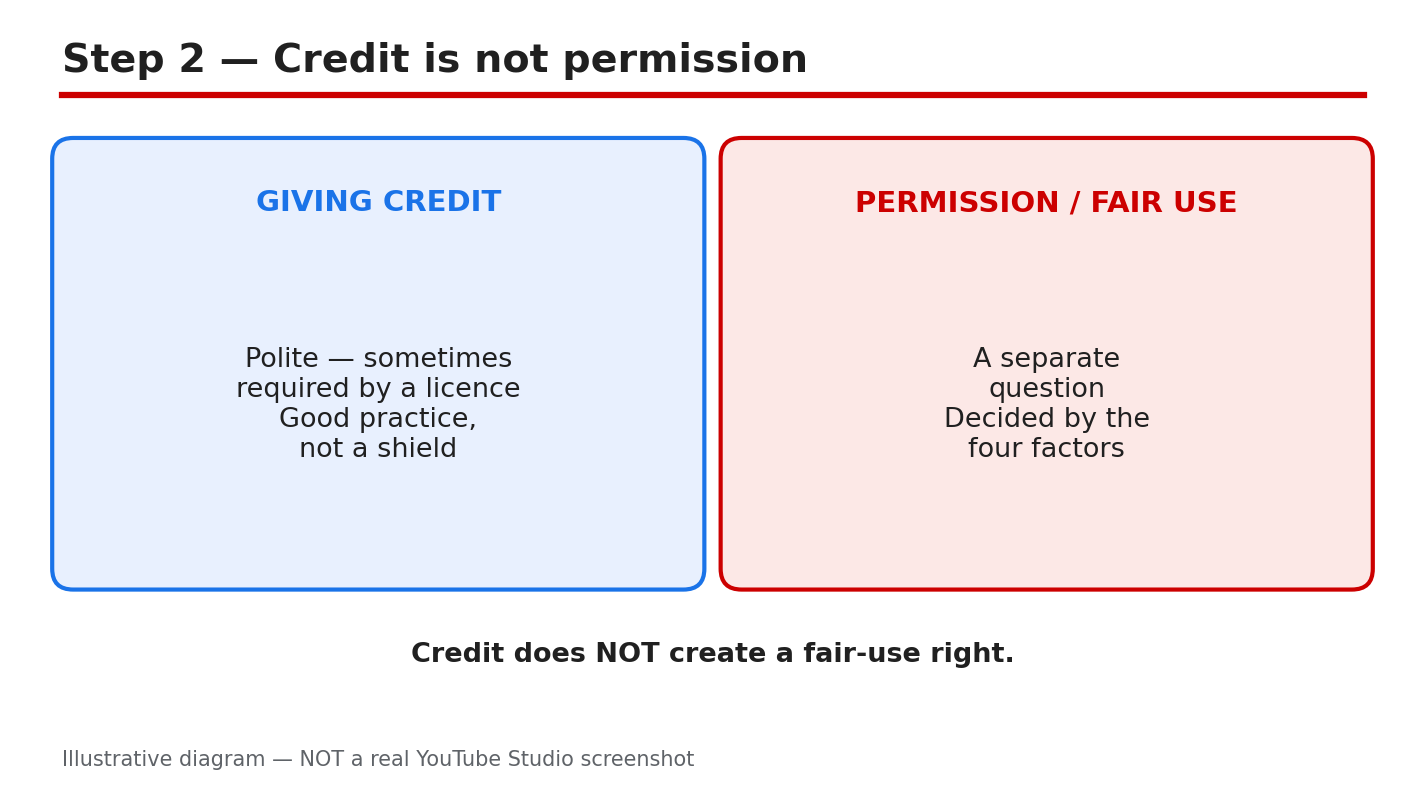
Illustrative diagram (mock-up): crediting the owner does not create fair use — not a real YouTube Studio screenshot.
Step 3: Understand the four factors as reported
What to do: Learn the four-factor test courts use, so you can judge your own video before you upload it.
How to do it: The four factors are: (1) purpose — adding new meaning is more likely to be fair than merely copying; (2) nature — factual material beats fiction; (3) amount — small bits beat large portions, but even a small sample can fail if it is the “heart” of the work; (4) market — uses that harm the owner’s ability to profit are less likely to be fair. Courts weigh all four together, as reported.
Example: A creator pauses a documentary scene every twenty seconds to explain the editing and challenge the narrator — Factor 1 (commentary), Factor 3 (short clips), Factor 4 (no substitute).
Common mistake: Scoring yourself on one factor and ignoring the rest.
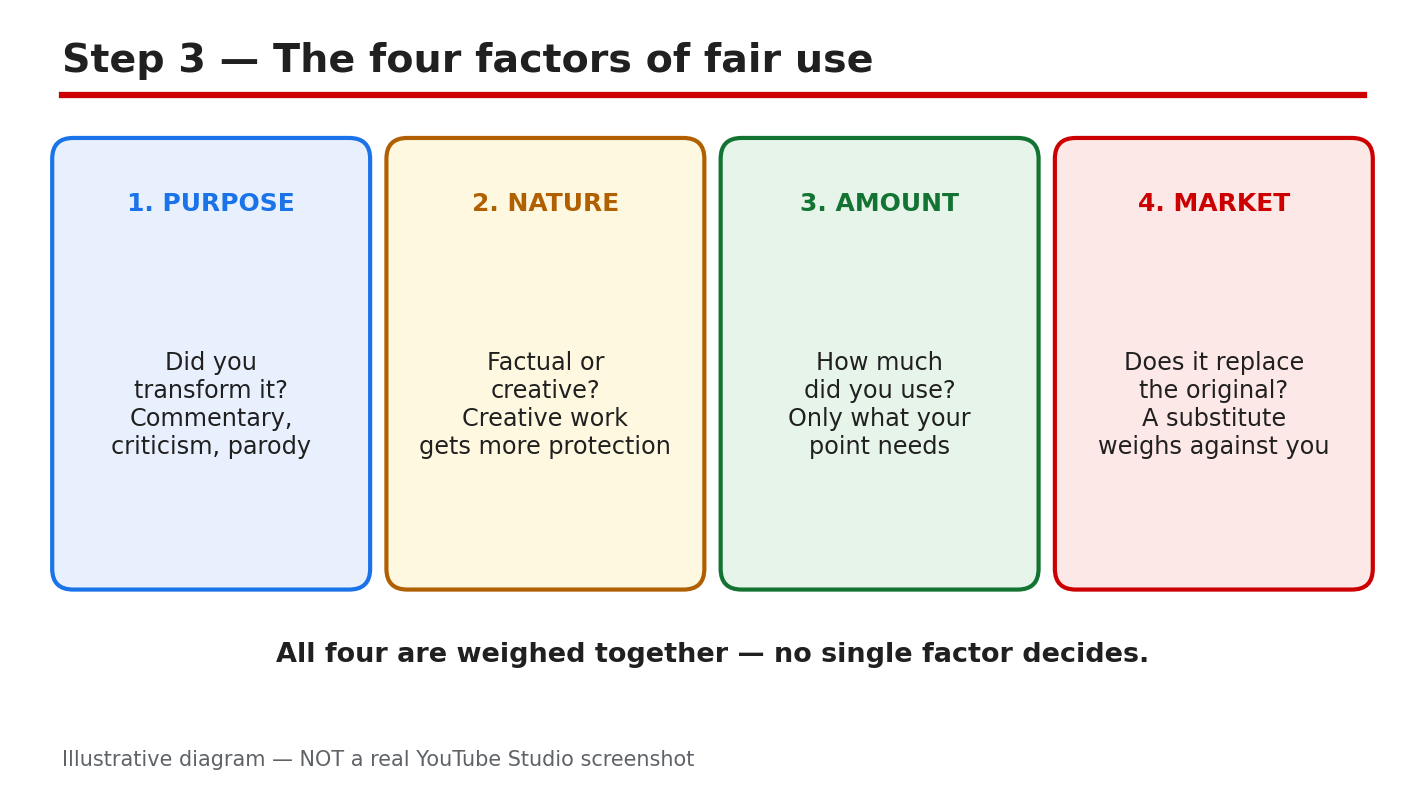
Illustrative diagram (mock-up) of the four fair use factors as reported — not a real YouTube Studio screenshot.
Step 4: Make your commentary do the heavy lifting
What to do: Build the video around what you add, not what you play.
How to do it: For every clip: show a short excerpt, pause the footage, explain or criticise what happened, add your own interpretation, and move on only when you have a new point. As reported, a strong reaction format pauses a scene to analyse its writing or explain a technique.
Example: Instead of playing a five-minute fail compilation straight through, a creator plays one clip, freezes it, explains why the stunt failed, and moves on — criticism, not a re-upload.
Common mistake: Watching a full video with the camera on and adding “wow” and a few laughs.
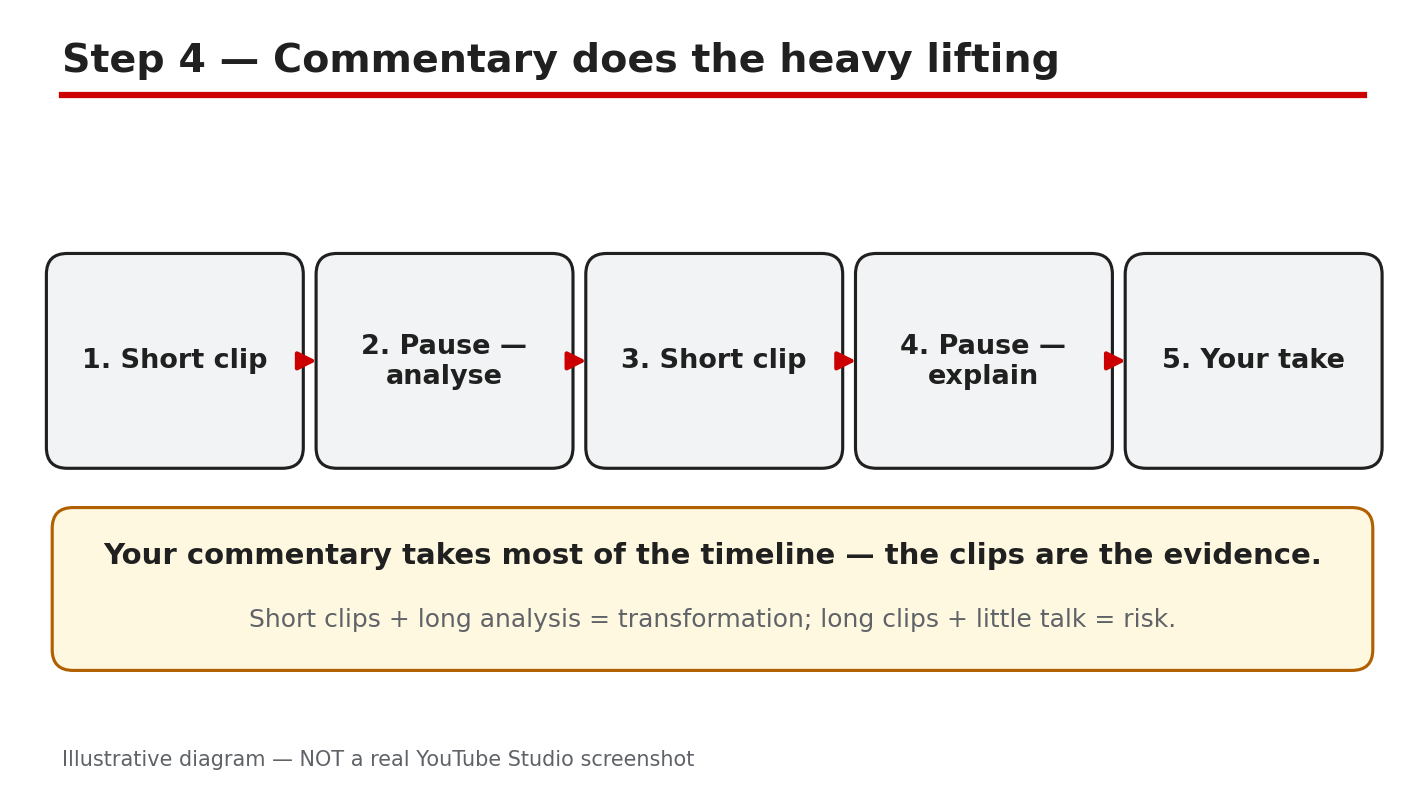
Illustrative diagram (mock-up) of a reaction video built around commentary — not a real YouTube Studio screenshot.
Step 5: Fix the “no monetization means no problem” myth
What to do: Stop treating a non-monetised upload as safe, because the law does not work that way.
How to do it: YouTube’s Help page says non-profit uses are favoured in the fair use analysis, but that is not an automatic defence by itself. As reported, non-monetised videos still get Content ID claims and takedowns.
Example: A creator uploads a reaction video with monetisation off, thinking the original owner has nothing to lose. It still gets a Content ID claim.
Common mistake: Believing a disclaimer plus no monetisation equals protection. Neither is a defence on its own.
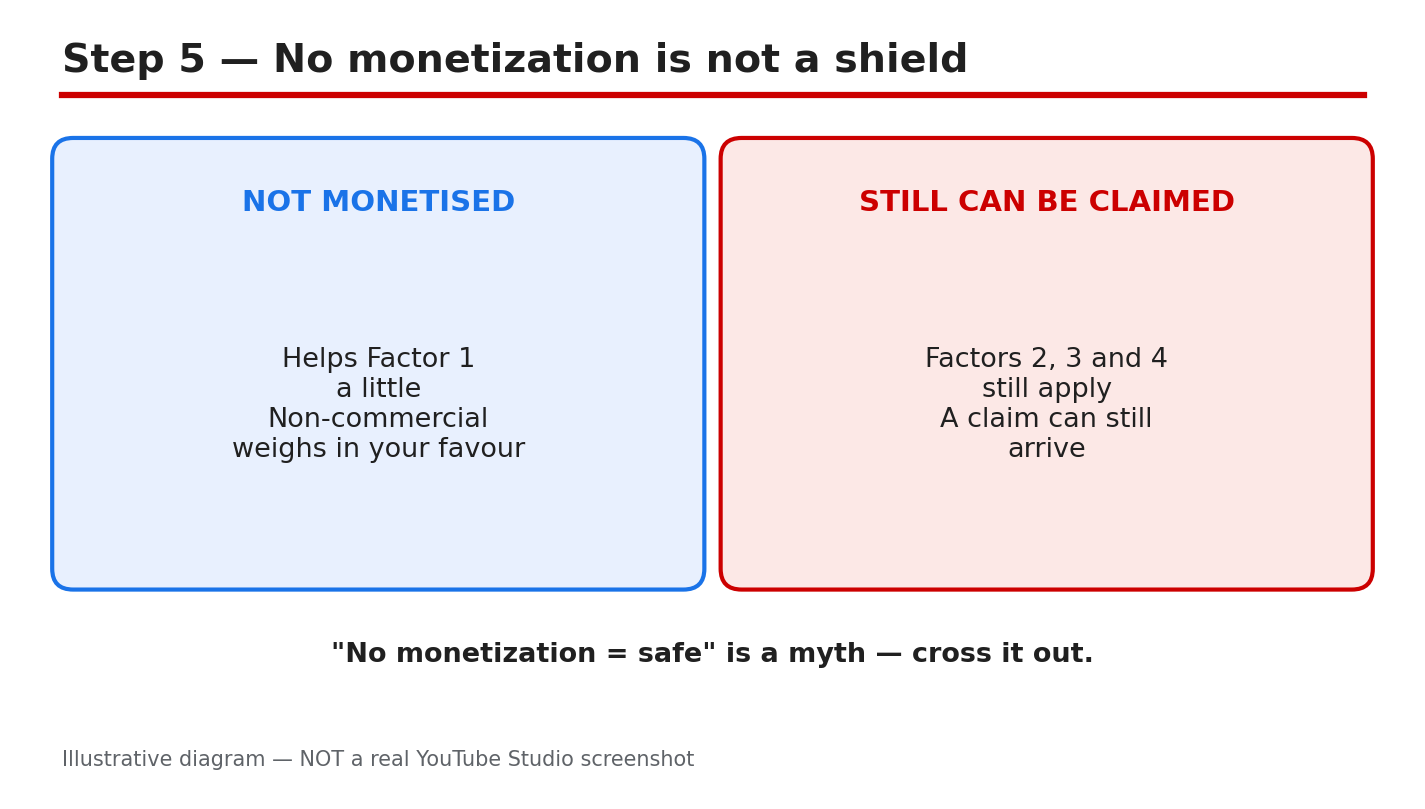
Illustrative diagram (mock-up): turning off monetization does not make a video safe — not a real YouTube Studio screenshot.
Step 6: Know what to do when a claim or takedown arrives
What to do: Have a plan before the first claim lands, so you react calmly instead of panicking.
How to do it: Read the claim in Studio under Content and Restrictions. A Content ID claim is not a copyright strike: as reported, a claim usually affects monetisation or availability, while a strike follows a formal takedown request. If the material is not essential, use Studio’s Trim, Replace, or Erase tools. If you believe the use is fair, you can defend it through the Content ID dispute process — but, as YouTube’s Help page says, this decision should not be taken lightly. Dispute only with a specific explanation and timestamps, and consider legal advice first.
Example: A commentary video gets claimed for a 40-second clip. The creator disputes with timestamps of the analysis around it, but trims another video where the clip was just background music.
Common mistake: Disputing every claim with “fair use” as the only reason, or deleting the video in a panic.
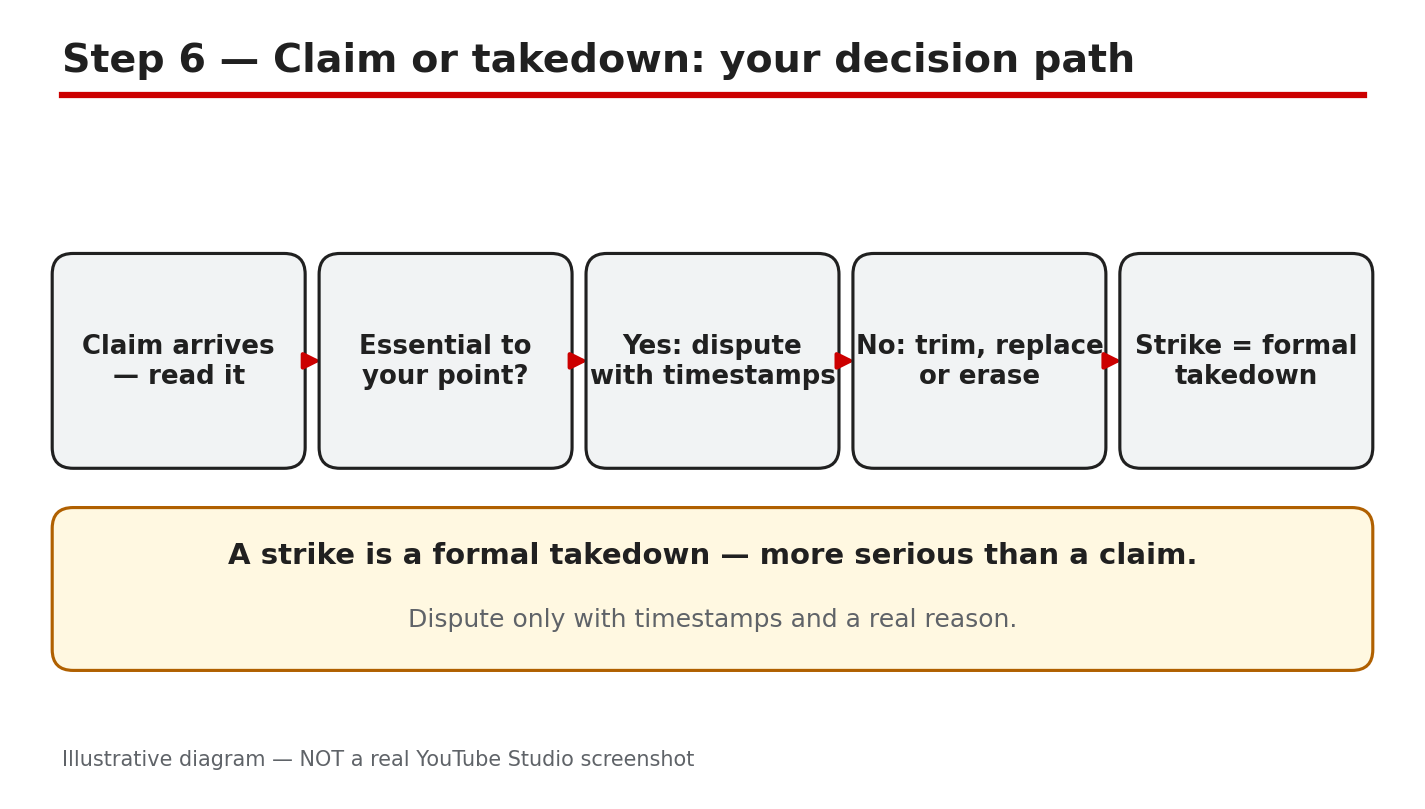
Illustrative diagram (mock-up) of the decision path after a claim or takedown — not a real YouTube Studio screenshot.
Checklist
- ☐ No “30 seconds is safe” rule used in your edit plan
- ☐ Credit given as courtesy, not as legal protection
- ☐ All four fair use factors considered, not just one
- ☐ Commentary makes up most of the video
- ☐ No “no monetization” assumption used as a shield
- ☐ Claim plan ready: fix, dispute, or leave it
Frequently asked questions
Is a reaction video automatically fair use?
No. As reported, calling something a “reaction” does not automatically make it fair use — courts weigh the four factors case by case.
Does giving credit in the description protect me?
No. YouTube’s Help page says giving credit will not by itself turn a non-transformative copy into fair use. Credit is polite, not a substitute for permission.
Can I use 30 seconds of a video without a problem?
There is no rule that makes 30 seconds automatically safe, as reported by the US Copyright Office. Courts look at how much you used and how important it was.
Does turning off monetization make my reaction video safe?
No. Non-profit use is only one consideration under the first factor, and YouTube’s Help page says it is not an automatic defence.
Should I dispute a claim on a reaction video?
Only with a genuine, specific fair-use explanation — what you added, which clips it covers, and timestamps.
Sources
- Fair use on YouTube — YouTube Help
- YouTube Copyright Claim? How to Trim, Replace or Erase the Song
- Can You Use Trending Audio on YouTube?
General information about fair use as reported, not legal advice. Confirm the current rules in YouTube Help before uploading.