Showing Posts From
Youtube policy
 CreatorPlaybook Team
- 10 Nov, 2026
YouTube Reused Content Rejection? How to Fix It, Appeal, and Reapply
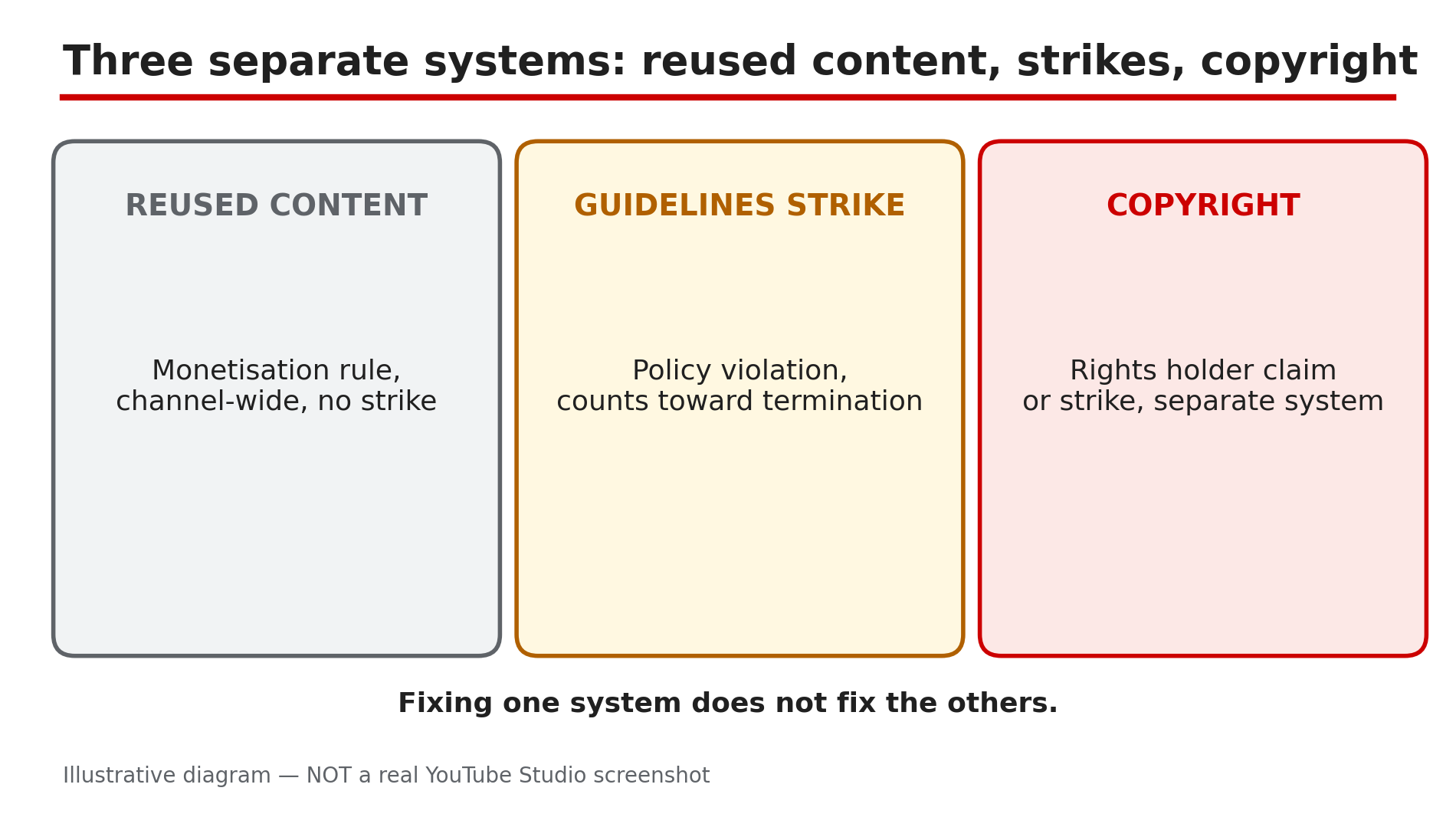
You applied to the YouTube Partner Program, waited weeks, and the answer came back: rejected for reused content. No strike, no copyright claim, no removed video — just a rejection that seems to blame your whole channel at once. That is exactly how this rule works: YouTube's Help page defines reused content as repurposing content already online without adding significant original commentary, substantive modifications, or educational or entertainment value — and it applies to your channel as a whole, not to one video. What You Will LearnWhat reused content is — and why it is not a strike or a copyright claim How reviewers judge your whole channel, not one video What counts as transformation, and what does not How to audit your channel and fix new uploads first How the appeal and reapplication windows work, as reportedStep 1 — Understand the rule: reused, not stolen, and not a strike What to do: Learn the three things reused content is not — each one changes your fix. How: First, it is a monetisation rule, not a Community Guidelines strike — it does not add to your strike count, and it does not remove videos. Second, it is not copyright: the policy applies even with the original creator's permission, and it is separate from copyright enforcement, so a video with no claims can still fail the review. Third, it is judged channel-wide: if reviewers cannot tell you made the content, monetisation may be removed from the entire channel. On 15 July 2025 YouTube renamed a related policy from "repetitious content" to "inauthentic content", but said the reused-content policy itself did not change. Example: A channel re-uploads sports highlights with the creator's written permission and no copyright claims. It is still rejected — permission answers the copyright question, not the reused-content question. Common mistake: Disputing a copyright claim to fix a reused-content rejection — the systems are separate, and a dispute changes nothing.Illustrative diagram: reused content, Community Guidelines strikes, and copyright are three separate systems. Step 2 — Audit your whole channel the way a reviewer does What to do: Review your channel as YouTube says its reviewers do, and be honest about how much of it is actually yours. How: YouTube's Help page says reviewers may focus on your channel's main theme, most viewed videos, newest videos, biggest share of watch time, metadata, and the About section. Open each and ask: could a stranger tell that you made this? A rejection usually means a significant portion of the channel fails, not one video, as reported. Do not delete everything in a panic — first map the problem, because the appeal and the rebuild both need that map. Example: A reaction channel finds 70 percent of its watch time comes from videos where it only nods at clips — those are the problem. Common mistake: Deleting the single video named in the rejection email — the rejection is about the channel, and one deletion rarely changes it.Illustrative mock-up: the six things YouTube reviewers check when they judge a channel for reused content. Step 3 — Fix new uploads first: what counts as transformation What to do: Make your next videos unmistakably yours, using the transformations YouTube's Help page lists as allowed. How: YouTube's Help page gives examples of what is allowed to monetise: clips used for a critical review, a movie scene with rewritten dialogue and a new voiceover, sports replays where you explain the moves, reaction videos with real commentary, and edited footage with your own storyline. The thread through all of them is that a viewer can tell there is a meaningful difference between the original video and yours. So for each new upload, add real commentary in your own voice and a storyline that is yours. Example: A clip channel stops posting raw highlights and starts posting five-minute breakdowns with its own voiceover and a verdict. The footage is the same, but the video is now its own work. Common mistake: Adding a logo watermark and calling the video transformed — a watermark adds no commentary or storyline.Illustrative diagram: what YouTube counts as transformation, and what it does not. Step 4 — Know what does NOT fix it What to do: Stop spending time on fixes YouTube's Help page explicitly lists as violations, however common they are. How: The Help page's list of what is not allowed includes clips from a favourite show edited together with little or no narrative, short videos compiled from other social media sites, collections of songs from different artists even with their permission, content uploaded many times by other creators, promotion of other people's content even with permission, and videos that only read out other people's material, like text from websites. Songs modified only to change the pitch or speed are also listed as violations — and since July 2026, reading out other people's material and pitch- or speed-shifted songs sit in the reused-content section, as reported. Example: A music channel pitch-shifts popular songs and adds a static image. Every upload is still reused content — the only change is one the Help page names as a violation. Common mistake: Believing that giving credit in the description fixes reused content — credit answers etiquette, not the policy.Illustrative diagram: an honest audit of how much of a channel is original work and how much is reused. Step 5 — Appeal within 21 days if you believe the rejection was wrong What to do: If you genuinely believe your channel was misjudged, appeal quickly — the window is short. How: YouTube's Community FAQ on reused content, posted by TeamYouTube, says you can appeal in Studio within 21 days of your suspension, with instructions on the Earn page, and appeals will receive a decision within 14 days — present both figures as reported, not as guarantees. The video appeal is a new unlisted upload under five minutes, as reported, with your channel URL in the first 30 seconds, in which you explain on camera how you create your content. Do not appeal before you have fixed anything if the rejection was fair: an appeal showing the same channel unchanged is likely to fail. Example: A documentary channel is rejected because its archival footage looks reused. It appeals with a video walking through its research and editing — and succeeds, because the original work was real, just not obvious. Common mistake: Appealing on day one with no changes — the reviewer sees the same channel and reaches the same conclusion.Illustrative diagram: the three steps of a reused-content appeal. Step 6 — Reapply after 30 days, or 90 days, with a rebuilt channel What to do: If the rejection was fair, use the waiting period to rebuild — then reapply only when the channel genuinely looks different. How: The reapplication windows are reported as 30 days after a first rejection and 90 days after later rejections — present them as reported, not as official guarantees, and confirm the exact window in your Studio Earn page. Use the wait properly: publish new videos that are clearly yours, following Step 3, and let them become a visible share of your most-viewed videos and watch time. Consider making the worst reused videos private or unlisted while you rebuild — the review looks at your channel as a whole. When the window opens, confirm your watch hours and subscribers still meet the threshold, and reapply. If rejected again, the next wait is longer. Example: A compilation channel spends its 30 days publishing daily breakdowns, unlists its old compilations, and reapplies on day 31 — accepted. Common mistake: Reapplying the day the window opens with the same channel unchanged — the second rejection costs a longer wait for nothing.Illustrative diagram: the reapplication windows after a reused-content rejection and what to do during the wait. Checklist — Fix a YouTube reused content rejection☐ Understood reused content is a monetisation rule, not a strike or copyright claim ☐ Accepted that permission from the original creator does not help ☐ Audited the channel the way reviewers do: theme, top videos, watch time ☐ Published new uploads with real commentary, storyline, and editing ☐ Stopped using pitch/speed shifts, readings, and bare compilations as fixes ☐ Decided between appeal (21 days, as reported) and rebuild-then-reapply ☐ Recorded a video appeal under five minutes if appealing ☐ Confirmed the reapplication window in Studio Earn (30 days first, 90 days later, as reported) ☐ Made the worst reused videos private or unlisted before reapplyingFAQs 1. What exactly is reused content on YouTube? Content repurposed from YouTube or another online source without significant original commentary, substantive modifications, or educational or entertainment value, according to YouTube's Help page. It is judged across your whole channel. 2. Is reused content the same as a copyright strike? No. Reused content is a monetisation policy, while copyright is enforced separately by rights holders. A video can have no copyright claim at all and still fail the review. 3. Can I appeal a reused content rejection? Yes, as reported: YouTube's Community FAQ says you can appeal in Studio within 21 days, with instructions on the Earn page, and appeals receive a decision within 14 days. The video appeal is a new unlisted upload under five minutes, as reported. 4. How long must I wait to reapply after a rejection? As reported, 30 days after a first rejection and 90 days after later rejections. Confirm the exact window in your Studio Earn page, and use the time to rebuild — see our guide on AI mass-produced content for the related rules. 5. Will deleting all my old videos fix the rejection? Not on its own. Reapplication is judged on what remains and what you added since — publish original work first, and make reused videos private or unlisted while you rebuild. SourcesYouTube Help — "YouTube channel monetization policies" (official page, opened live 10 Nov 2026): https://support.google.com/youtube/answer/1311392 CreatorPlaybook — "AI Mass-Produced YouTube Videos: Why They Fail Monetisation" (internal link, live-verified published post): </blog/ai-mass-produced-youtube-videos-2026> CreatorPlaybook — "YouTube Spam Termination Explained: Why Channels Get Removed" (internal link, live-verified published post): </blog/youtube-spam-termination-explained-why>
- CreatorPlaybook Team
- 01 Nov, 2026
Livestream Policy Violations on YouTube: Crypto, Gambling & Giveaways — Strikes Explained
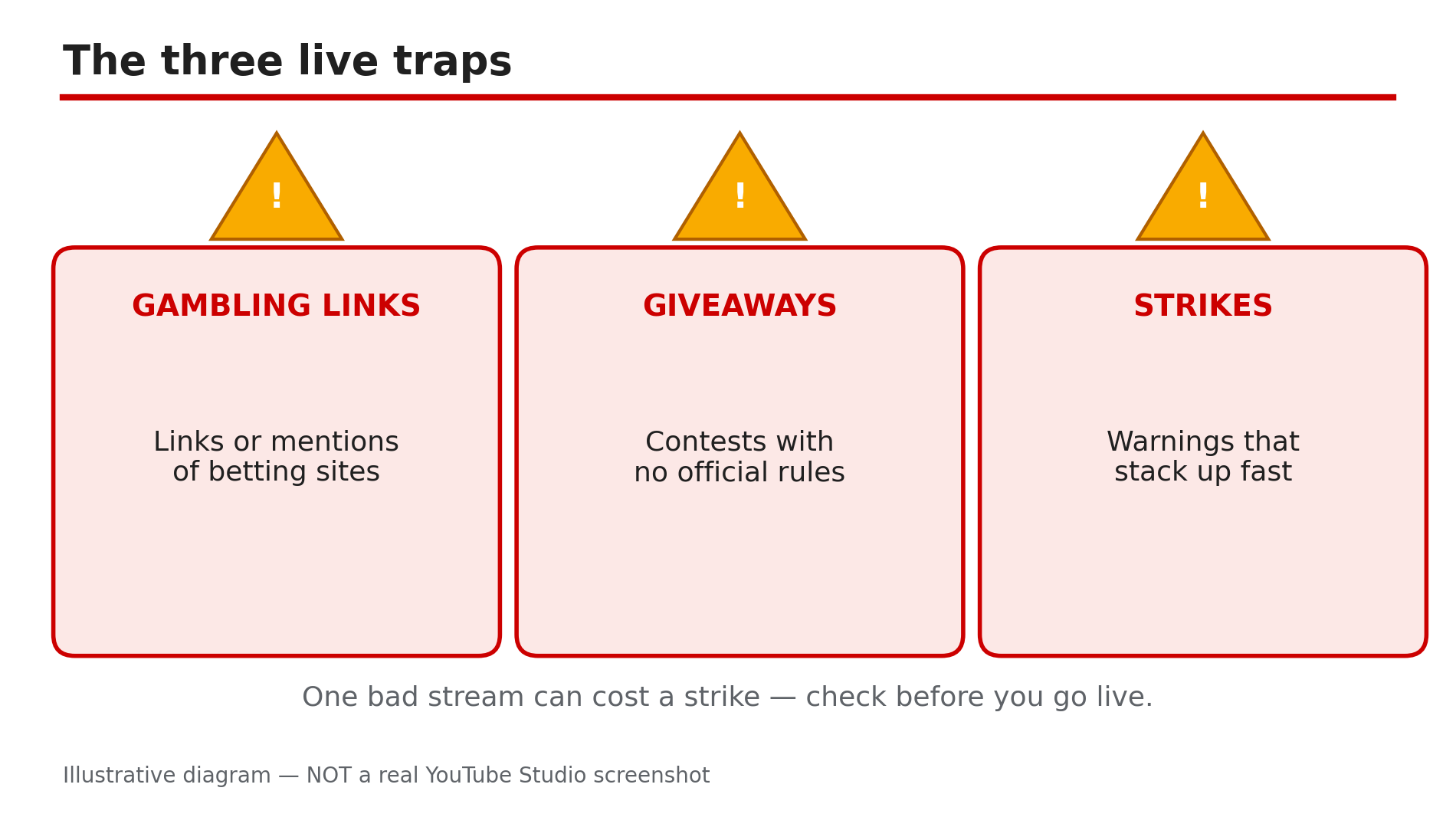
A livestream feels casual — you are talking, the chat is moving, a link or a giveaway seems harmless. But live is the riskiest format for policy mistakes: everything you say, show and link is judged in real time, and one bad stream can cost you a strike, a week without uploads, or your channel. This post covers the three traps that catch livestreamers most: gambling promotion, contests and giveaways, and the strikes that punish them. The rules below come from YouTube's Help pages, opened live for this post; anything reported rather than confirmed there is labelled as reported. What You Will LearnWhat the gambling policy bans on live — and what it does not Why crypto itself is not banned, but crypto gambling promotion is The gambling update of 28 Oct 2025 (effective 17 Nov 2025) The contest rules every live giveaway must follow Why "subscribe and like to enter" can get a stream removed How live strikes work: warnings, 1- and 2-week bans, terminationStep 1 — Check Every Link Before You Go Live What to do: Check every link you plan to share — description, pinned chat, on screen, or spoken aloud — and confirm it does not lead to a gambling site or app. How: YouTube's regulated-goods policy, opened live for this post, bans content that sells, links to, or facilitates access to "uncertified online gambling sites". It applies to videos, descriptions, comments and live streams, including verbal direction to other sites. A spoken "link in description" counts the same as a clickable link. Example: A sponsor offers you money to mention a betting site on a gaming stream. You check Google's certification list, find it is not certified, and drop the read. Common mistake: Assuming only clickable links count. Saying a site name, showing it on screen, or a QR code still directs viewers to it.Illustrative diagram — the three policy traps that catch livestreamers most often. Not a real YouTube Studio screenshot. Step 2 — Keep Crypto Talk Educational, Never a Gambling Funnel What to do: Talk about crypto however you like — prices, news, blockchain — but never use it as a bridge to gambling. How: Crypto itself is not banned on YouTube. The violation is when crypto content becomes gambling promotion — a stream showing a "crypto casino". As reported, the gambling update (announced 28 Oct 2025, effective 17 Nov 2025) covers gambling with digital goods such as skins and NFTs, and bars directing viewers to uncertified gambling sites and apps. Showing skins or NFTs, or discussing blockchain, is not targeted unless it directs viewers to gambling. Example: You discuss NFT prices — fine. Then you open a site where viewers can gamble those NFTs on coin flips and read out the sign-up link. That crosses the line. Common mistake: Believing "crypto is banned", or the opposite, "anything crypto-related is allowed". Both are wrong — the question is always: does this content direct viewers to gambling?Illustrative diagram — certified vs uncertified gambling sites. Not a real YouTube Studio screenshot. Step 3 — Age-Restrict Gambling and Social-Casino Content Yourself What to do: If your stream features gambling or social-casino content at all, set the audience as not suitable for under-18s, and expect YouTube to age-restrict it anyway. How: The Help page lists as age-restricted anything that "facilitates access to, promotes or depicts online gambling and social/sweepstakes casinos, including content from certified sites". Even certified-site content is age-restricted. Exception: sports betting from Google-certified providers during a live sporting event may be allowed for all audiences. As reported, the October 2025 update also age-restricted social-casino content with no real money involved. Example: You stream a free social-casino game with no real money — set it as age-restricted in Studio before going live. Common mistake: Thinking "no real money, no problem". A social casino with play chips can still be age-restricted — mark it yourself.Illustrative diagram — crypto discussion is allowed, a gambling funnel is not. Not a real YouTube Studio screenshot. Step 4 — Write Official Rules Before Any Live Giveaway What to do: Never announce a giveaway on a livestream without written official rules viewers can read. How: YouTube's contest policy page, opened live for this post, applies to all contests run on YouTube or using YouTube. Official rules must link to the Community Guidelines, state legally required disclosures, state that YouTube is not a sponsor, require viewers to release YouTube from liability, and include a privacy notice for collected personal data. You are solely responsible for your contest, it must follow all relevant laws, and it cannot run through ad units. Example: Before a live headset giveaway, you publish short rules: who can enter, the deadline, how the winner is picked, the privacy notice, and the line "This giveaway is not sponsored, endorsed or administered by YouTube." Common mistake: Announcing the prize and promising to "write the rules later" — if a viewer reports the stream, there are no rules to point to.Illustrative diagram — the five things every live giveaway's official rules must include. Not a real YouTube Studio screenshot. Step 5 — Never Make Subscribe, Like or Comment the Entry Ticket What to do: Let viewers enter with a free action that does not inflate your metrics — for example, a chat message with a keyword — with subscribing, liking and commenting optional. How: The contest policy requires free entry and bans manipulating views, likes, dislikes or subscribers to misrepresent engagement. As reported, the fake-engagement policy goes further: content that exists only to reward engagement can be removed. That is why "subscribe and like to enter" is the most dangerous giveaway line on YouTube. Example: Entry is typing "!prize" in live chat before a time you announce on screen, while you say subscribing is appreciated but not required. Common mistake: Making entry conditional on subscribing, liking, or watching for a set time. You may encourage subscribing and liking; you may not make a prize the reason they do it.Illustrative diagram — how Community Guidelines strikes escalate for livestreamers. Not a real YouTube Studio screenshot. Step 6 — If You Get a Warning or Strike, Stop and Read the Email What to do: If a stream is removed or you get a warning or strike, do not go live again with the same content. Read YouTube's email, find the exact policy named, and decide whether to appeal or wait it out. How: Violating content is removed and YouTube emails you. A first violation usually gets a warning with no penalty; policy training can let it expire after 90 days. As reported, a first strike blocks uploads, live streams, posts, Premieres and custom thumbnails for one week; a second, two weeks. A copyright removal of an active livestream is also reported to bring a strike plus a 7-day live block (a second, 14 days). Confirm timings in Studio. Example: Your gambling stream is removed with a warning email naming the regulated-goods policy. You complete the policy training, remove every gambling link, and do not repeat the format. Common mistake: Deleting the video, or going live to "explain what happened" while a strike is active. Deleting the video does not remove a strike, and a second violation makes things worse.Illustrative diagram — the two-minute pre-stream policy check. Not a real YouTube Studio screenshot. Checklist — Before Every LivestreamAll links checked — no uncertified gambling site No promised guaranteed returns from gambling Crypto content educational only — no funnel to a casino Gambling or social-casino content set as age-restricted Giveaway rules published before the stream Entry is free; subscribing, liking, commenting not required Rules say YouTube is not a sponsor Privacy notice covers personal data collected from entrants No active warning or strike in Studio before going liveFAQs 1. Is crypto banned on YouTube livestreams? No. Talking about prices, news or blockchain is allowed. What is banned is using crypto content to promote or direct viewers to uncertified gambling, for example a crypto casino. As reported, the October 2025 update also covers gambling with digital goods. 2. Can I stream myself playing at an online casino? Only with great care. Gambling content is age-restricted even from certified sites. Directing viewers to an uncertified site is not allowed and promising guaranteed returns is banned for any site. Check the Help page in Sources and local laws first. 3. Can I say "subscribe and like to enter" in a live giveaway? You should not. The contest policy bans manipulating views, likes, dislikes or subscribers, and the fake-engagement policy targets content that exists only to reward engagement. Encourage subscribing and liking, but do not make them the price of entry — use a free chat entry instead. 4. What happens if my livestream gets a strike? As reported, a first strike blocks uploads, live streams, posts, Premieres and custom thumbnails for one week; a second, two weeks; a third within 90 days can terminate the channel. A first violation is usually a warning. Check the exact restriction in Studio. 5. My stream was removed but I think it was a mistake — can I appeal? Yes. Appeal in Studio (Settings > Channel > Channel violations > Appeal). Appeals are usually one per strike, filed within the window in YouTube's email. Keep it short: state what the stream was, which part of the policy was misapplied, and nothing else. SourcesYouTube Help — "Illegal or regulated goods or services policies" (opened live 1 Nov 2026): https://support.google.com/youtube/answer/9229611?hl=en-GB YouTube Help — "YouTube's contest policies and guidelines" (opened live 1 Nov 2026): https://support.google.com/youtube/answer/1620498?hl=en-GB Related on CreatorPlaybook — "YouTube Monetization Paused vs Disabled vs Rejected": </blog/youtube-monetization-paused-vs-disabled>Note: The gambling update (28 Oct 2025 announcement, 17 Nov 2025 effective) and the live strike durations are reported from third-party coverage and the plan file's pre-verification notes, not from the Help pages opened live for this post. Confirm the current wording in Studio and the Help pages above before you go live.